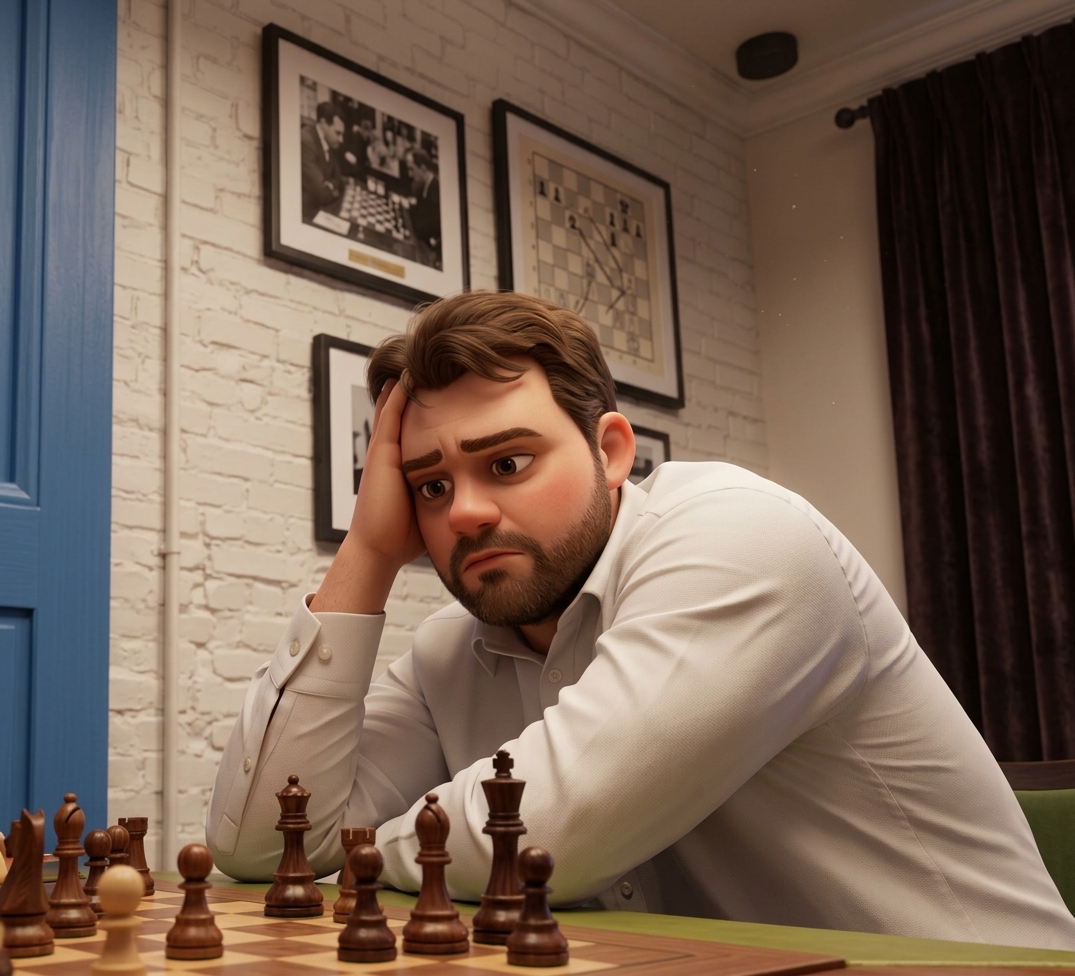
Illustration of Sam Shankland at the chessboard. This is not a real picture of Sam Shankland, and the pieces shown are not from this game.
Let us start with a puzzle from the game. It is White to move, and the black pawn on f3 has just given check. White has three legal king moves. Two of them lose to checkmate. Which one keeps the game going? The answer is in the article.

 7
7


 2
2
 e
eWhite to move, after 39...f3+. Three legal king moves. Two of them lose to checkmate. Which one keeps the game going?
Jeffery Xiong 0-1 Sam Shankland 2026 U.S. Chess Championship, Saint Louis · Round 3 · 11 October 2026 White: GM Jeffery Xiong (2656) · Black: GM Sam Shankland (2646)
Board 1 in round 3
The U.S. Championship is a round robin at the Saint Louis Chess Club: 12 players, each meeting every other player once over 11 rounds. Each player gets 90 minutes for the first 40 moves, then 30 more minutes, plus 30 seconds for every move.
Both players had already lost to Wesley So: Xiong in round 2, and Shankland, the 2018 U.S. champion, in round 1. Shankland drew with Ray Robson in round 2.
This article follows the whole game. Its lesson is about opening the enemy king: sometimes a piece is worth giving up for pawns, if the pawns it takes were the ones guarding the king.
The Game: Xiong v Shankland
The opening: a pawn on its own
1.d4 Nf6 2.Nf3 g6 3.Nc3 d5 4.Bf4 Bg7 5.e3 O-O 6.Nb5 Na6 7.h3 Ne4 8.c3 c6 9.Na3 f6 10.Bh2 e5
Xiong brought his bishop out to f4 early. Shankland castled, put a knight on e4 and pushed his e-pawn to e5 to fight for the centre.
11.Be2 exd4 12.Nxd4 Nac5 13.O-O Ne6 14.c4 Nxd4 15.exd4 Be6 16.cxd5 Bxd5
After the trades, White had a pawn on d4 with no white pawn on the c-file or the e-file next to it. That is called an isolated pawn. No pawn can ever protect it, so pieces have to do the job.
87
 32
32 1adfg
1adfgAfter 16...Bxd5. The white pawn on d4 is isolated: there is no white pawn on c- or e-file beside it.
Our Stockfish 17.1 check at depth 20 rated the position close to level here, with Black very slightly better.
Moves 17 to 26: Black wins the d-pawn
17.Nc4 Re8 18.Re1 f5 19.f3 Ng5 20.Qd2 Ne6 21.Be5 Qh4 22.Nd6 Re7 23.Bc4 Bxc4 24.Nxc4 Rd8
Shankland's pieces lined up against the d4 pawn: the knight on e6 and the rook on d8. His queen went to h4, close to White's king.
25.Kh1 Bxe5 26.Rxe5
Xiong spent about 25 minutes on 25.Kh1 and had under 20 minutes left after it. Shankland still had almost an hour.
721ahAfter 26.Rxe5, Black to move. Count the attackers on d4: the queen on h4, the knight on e6 and the rook on d8. Only the white queen on d2 defends it.
26...Nxd4 27.Rxe7 Qxe7 28.Re1 Qh4
Three attackers against one defender means the pawn falls. The knight took it, the rooks came off on e7, and Black was a pawn ahead. Our engine rated Black about one pawn better.
Move 29: the knight goes into the king's shelter
29.Qe3 Nxf3
This is the move of the game. The black knight took the pawn on f3, right in front of White's king. White's g-pawn can take the knight. Shankland gave it anyway.
72ehAfter 29...Nxf3. The knight has taken the f3 pawn. White's g2 pawn can take it, but then the pawns around the white king will be gone.
Our engine chose 29...Nxf3 as Black's best move. Here is why it works:
30.Qe6+ Kg7 31.gxf3 Qxh3+ 32.Kg1 Qg3+ 33.Kh1 Qxf3+
White first gave a check, then took the knight. But now the black queen ate the h3 pawn with check, and then the pawn on f3 with another check. Count what Black got for the knight: the f3 pawn the knight took, the h3 pawn, and White's old g-pawn, which had moved to f3. That is three pawns for the knight, and with the d4 pawn from earlier, Black had four pawns for a knight. White's king had no pawns left in front of it.
Move 36: the king steps onto the wrong square
34.Kg1 Qg4+ 35.Kf2 Qh4+ 36.Kg2
The checks kept coming, and Xiong had less than six minutes left after 36.Kg2. Before that move, our engine rated Black about two pawns better. Its top four choices were other king moves, Kf1, Kg1, Kf3 and Ke2, and each kept it near two pawns. After 36.Kg2, Black was more than four pawns better.
72eAfter 36.Kg2, Black to move. The black rook on d8 is ready to come to d4, where it attacks the knight on c4 and joins the attack.
36...Rd4
The black rook joined in. It attacked the knight on c4 and got ready to swing over to f4.
The f-pawn marches
37.Qe5+ Kh6 38.Qe3+ f4 39.Qe8 f3+
White checked twice, and the black f-pawn blocked a check on f4. Then it moved again, to f3, with check. Xiong had 32 seconds left. This is the puzzle position from the start of the article.
White has three legal moves, all with the king. Our engine finds checkmate after two of them:
- 40.Kg1 loses to 40...Qg3+ 41.Kf1 Qg2#. The queen on g2 is guarded by the pawn on f3.
- 40.Kxf3 walks into a checkmate in seven moves.
- 40.Kf1 is the only move that avoids a fast mate.
40.Kf1
Xiong found it. With move 40 played, both players got 30 more minutes.
The finish
40...Rf4 41.Re6 Qg3 42.Ne3 f2
Black's rook went to f4, behind its pawn, and the queen went to g3. Then the pawn stepped to f2. It stood one square from the last rank, guarded by the rook on f4, with Black's queen next to White's king. The game ended there, 0-1.
72fThe final position, after 42...f2. The pawn on f2 is one square from becoming a queen, and the rook on f4 guards it from behind.
After round 3, Wesley So and Awonder Liang lead with 2.5 points out of 3. Shankland has 1.5 and Xiong has 1.
What to Learn
1. An isolated pawn needs pieces to guard it. No pawn can protect the d4 pawn, so when Black aimed three pieces at it and White had one defender, the pawn fell.
2. A piece for the pawns around the king can be a good deal. After 29...Nxf3, Black had three pawns for the knight, and White's king had nothing in front of it. The queen then gave check after check.
3. When your king is in check, look at every square. On move 40, White had three king moves and two of them lost to checkmate. Before you move your king, ask: what checks can my opponent give next, and where will my king go then?
4. Passed pawns get stronger as they move. A passed pawn has no enemy pawn in front of it or on the files beside it. Black's f-pawn went f5, f4, f3, f2. Each step, it took more squares away from White's king.
Related Stories
tournaments • 2026-10-11
A Pawn on e6 and a Rook on the Seventh: Abrahamyan Beats Yip in Round 3
tournaments • 2026-10-11
The King Went the Wrong Way: So's Birthday Endgame Against Shankland
tournaments • 2026-10-10
One Knight, Two Rooks: Wesley So Beats Jeffery Xiong in Round 2
tournaments • 2026-10-10