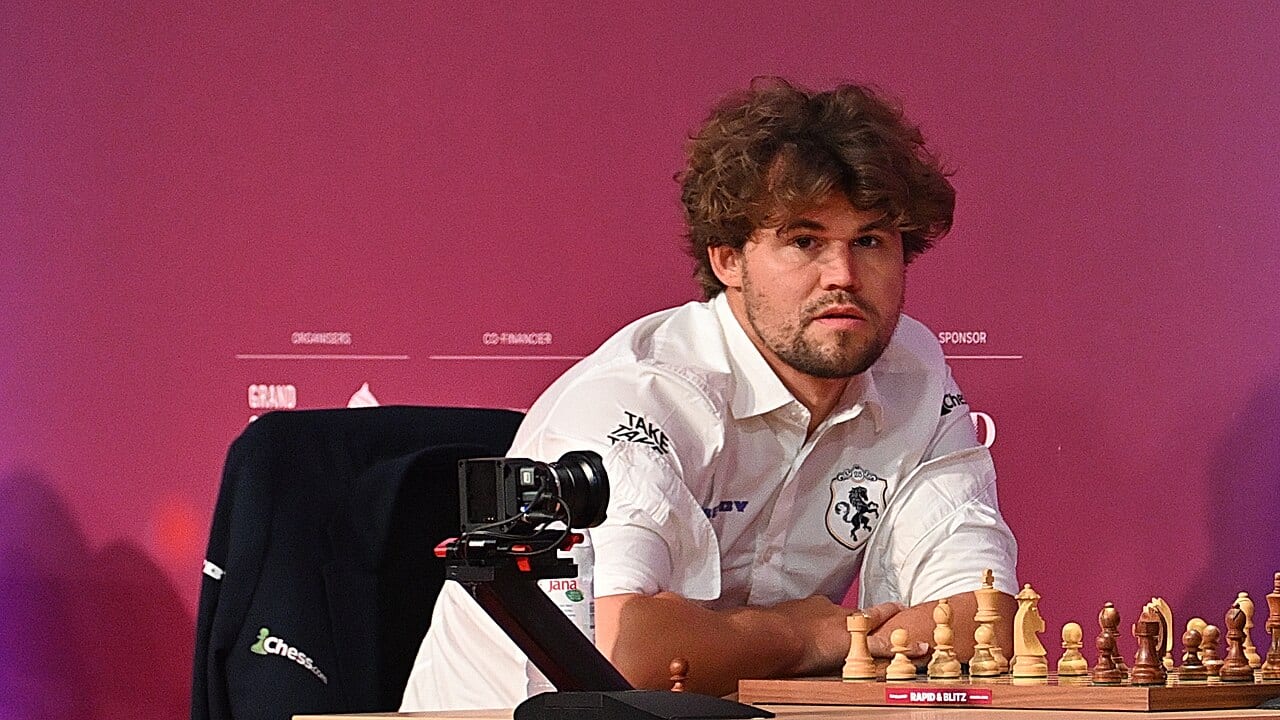
Photo: Miroslav.vajdic / Wikimedia Commons (CC BY 4.0)
Imagine winning four games in a row and still losing the match.
That can happen in Budapest this month. In the knockout rounds of Total Chess 2026, a player who wins all four blitz games of the day collects 4 points. Say the two rapid games are then drawn and the opponent, who has lost every blitz game, wins the one long game that closes the day. The opponent finishes the day ahead, 12 points to 8. One slow win is worth as much as two rapid wins, and twice as much as four blitz wins.
The tournament runs from November 10 to 21 at the Anantara New York Palace Hotel in Budapest. Twenty-four players are in it, and two of them have been on this site before: Magnus Carlsen, the world number one, and Wesley So, the world number 6 and the reigning United States champion.
"I look forward to playing the Total Chess World Championship in Budapest this year," Carlsen said before the event. "It's always interesting to try out new formats."
Three clocks, one trophy
Most tournaments pick one speed and stay with it. This one does not. Every player has to handle three.
| Name | Time for the whole game | Added after every move |
|---|---|---|
| Fast Classical | 45 minutes | 30 seconds |
| Rapid | 15 minutes | 10 seconds |
| Blitz | 3 minutes | 2 seconds |
Fast Classical is the unfamiliar one. Forty-five minutes is far less than a normal classical game, where players often get two hours or more, and far more than the 15 minutes of a rapid game. It is long enough to work something out and short enough that you cannot check it three times.
The idea behind the whole event is in its name. It is looking for the player who is best at all three, rather than the player who is best at one.
The blitz night that comes first
On November 10, before a single serious game, all 24 players sit down for nine rounds of blitz at 3 minutes plus 2 seconds. Nobody wins a prize for it.
What they win is the order. Where you finish that night becomes your tiebreak for the whole group stage, and it also decides who you play in the knockout semifinals. If two players in a group finish level on points, the one who did better on that blitz night is ranked above the other. The quickest games of the tournament settle the slowest ones.
Five days in a group of six
From November 11 to 15, the 24 are split into four groups of six. Inside each group everyone plays everyone twice, once with White and once with Black. That is two games a day for five days, 10 fast classical games each.
The scoring here is borrowed from football. A win is 3 points, a draw is 1, a loss is 0. Do the arithmetic for the 10 games. Draw every one of them and you finish on 10 points. Win four and lose six, which feels much worse, and you finish on 12. Safety does not pay here. There is one more rule holding the players to the board: in a fast classical game neither player may offer a draw until both of them have made 30 moves.
Nobody goes home early
Then comes the part most tournaments do not have. The group stage does not knock anyone out. It sorts them.
The four group winners go into Knockout Bracket 1, the four players who finished second go into Bracket 2, and so on down to Bracket 6 for the four who finished last. Every bracket has its own semifinals, its own third place match and its own final. Everyone keeps playing to the end.
Only the winner of the Bracket 1 final wins Budapest.
Each knockout match is played over two days, and each day runs through all three speeds in the same order: four blitz games first, then two rapid games, then one fast classical game. Here is what each result is worth on the day.
| Game | Win | Draw |
|---|---|---|
| Blitz (four of them) | 1 | 0.5 |
| Rapid (two of them) | 4 | 2 |
| Fast Classical (one) | 8 | 4 |
Add it up. The four blitz games are worth 4 points in total, the two rapid games 8, and the single fast classical game 8 on its own. A player who is losing all day has one game left that can rescue the whole day, and a player who is winning all day can give it all back in that last game.
The score goes back to zero on the second day. If each player wins one day, or both days are tied, they play an Armageddon game. White gets 10 minutes, Black gets 7 minutes with 1 second added from move 41, and a draw counts as a win for Black. The player with more points across the two days chooses the colour.
First prize is 80,000 dollars. Last place, 24th, is paid 10,000, and the 24 prizes add up to 650,000 dollars.
Three clocks, three different questions
Here is what changes for you, and for them, as the clock gets smaller.
At 45 minutes, you can carry out a plan


 6


Nodirbek Abdusattorov against Fabiano Caruana, Chess Olympiad 2026. Black to move. Look at where the white king is standing: h4, high up the board and on the same row as Black's rook on d4.
Both of these players are in Budapest. In this rook ending Abdusattorov did something that looks reckless and is not. He walked his king up the board, square by square, towards Caruana's side. A king is a fighting piece once the queens are gone, and in a long game you have time to march it.
You cannot do that in three minutes. Each step needs checking, because one wrong square and the rook starts giving checks forever. That is what a long clock buys: a plan that takes several moves to finish. The whole game is in the king walks in.
At 15 minutes, one move decides it


 3

 21adh
Wesley So against Fabiano Caruana, United States Championship playoff 2026. Black to move. The white queen on c3 looks up the c-file at the bishop on c6 and along the long diagonal at the rook on e5.
This came from a rapid playoff at 15 minutes plus 10 seconds, the exact time control Budapest uses. So had just recaptured on c3 with his queen, and that one queen now attacked two pieces at once. Nothing guards the bishop on c6. The rook on e5 is hit by the queen and by the pawn on f4 as well.
When one piece attacks two things at the same time, it is called a double attack, and the answer has to deal with both at once. There is exactly one here. Black plays 21...Rc5, which steps the rook out of danger and parks it in the path between the queen and the bishop, where two black pieces guard it. Caruana had 35 legal moves in that position. We checked every one of them with our engine, and 21...Rc5 was the only one that did not lose a piece.
He played 21...b4 instead, attacking the queen. The queen did not run. It took the bishop, and So was a piece ahead. See the double attack that won the title.
At 3 minutes, you have to know it already
87 2cde
Magnus Carlsen against Sergey Dolmatov, Moscow 2004. White to move. The black king sits on d8 and has never castled. The white rook on e1 stares straight at the bishop on e7.
Carlsen was 13 when he reached this position. He played 14.Rxe7, giving a whole rook for a bishop. The point is not the material. The point is that the bishop on e7 was the last thing standing between a white rook and a king that never found a safe home, and after the capture the lines around that king come open. The game was finished by move 19.
In blitz there is no time to count this out. What you have instead is the pattern: an enemy king stuck in the middle, your rooks on the open files, a defender you can remove. You recognise it, or you miss it. Carlsen's early games are in the memory monster.
What Budapest is really for
This is a pilot, which is a polite word for a first try. It was developed by Norway Chess, approved by FIDE and is being run with the Hungarian Chess Federation, and the rules say plainly that the Grand Final's rules can still change based on what happens here.
The real thing starts in 2027: four tournaments in four cities, with the four best players across the tour meeting in a Grand Final. The winner of that final becomes the first FIDE World Combined Champion, a world title for all three speeds at once. The tour also carries two places in the 2028 Candidates Tournament, the event that decides who plays for the classical world title. Budapest also sends three of its players straight into the first leg next year.
Two names are missing from the field. Gukesh Dommaraju, the world champion, is not in Budapest, and neither is Javokhir Sindarov. The two of them begin their World Championship match in Geneva, with the first game on November 24.
What to learn from this
- The scoring tells you how to play. Before any tournament, find out what a draw is worth. In the Budapest groups 10 draws score less than four wins and six losses, and in the knockouts one fast classical win is worth eight blitz wins.
- A long clock is for plans, a short clock is for patterns. Spend your slow games building ideas that take several moves. Spend your fast games on shapes you already recognise.
- Count the defenders. A piece guarded by nothing is a target, and a queen that attacks two of them wins one.
- Your king is a piece. Once the queens come off, walk it towards the action rather than hiding it in the corner.
- Losing early is not the end. In this format every player who finishes last in a group still has a bracket, a semifinal and a final to play.
Now try it
Pick one position and give yourself 45 minutes. Then pick another and give yourself three. You will notice that they ask you for completely different things.
Our puzzle trainer is the place for the slow version, where you write down the whole line before you move. The puzzle sprint is the fast one, where you go on what you recognise. Train both. That is exactly what this tournament is asking its 24 players to do.
Read next
Carlsen is not the only one in this field we have followed from the start. Wesley So learned the game from books in Bacoor, in the Philippines, with nobody to teach him: the boy with no coach.
Update: Day 1 is done. Carlsen won the blitz night and Rapport beat Caruana.