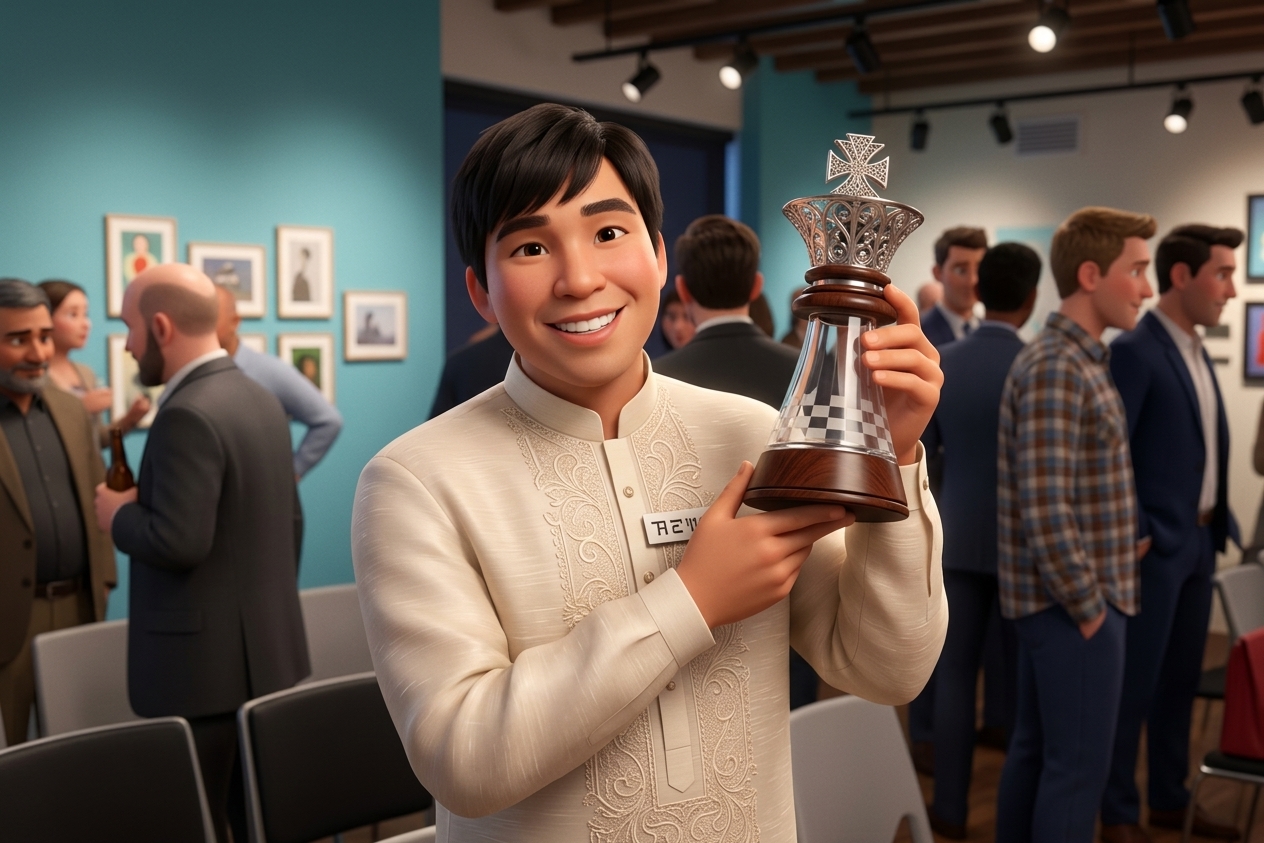
Illustration, not a photograph of Wesley So or of any real event.
Some champions win with fireworks. Wesley So wins by making the position agree with him, one accurate move at a time, until his opponent has nothing left to try. That quiet style did not come from a famous coach or an academy. It came from a boy in Bacoor, Philippines, who learned the game from photocopied books and games played on the street.
A Self-Taught Start
Wesley So was born on October 9, 1993, in Bacoor, in the Philippines. He started playing in junior tournaments at around age 10 and won the under-10 section of the 2003 Philippine National Chess Championships. There was no famous training academy behind him. He studied on his own, playing and replaying games from whatever books and newspaper clippings he could find, and testing his ideas against other kids in the neighborhood.
That kind of self-study is slow. It also builds something a coach cannot hand you: the habit of figuring things out for yourself, move by move, instead of waiting to be told the answer.
The results came fast once the habit was in place. So earned his final grandmaster norm on December 8, 2007, at the Pichay Cup in Manila. He was 14 years old, the youngest Filipino ever to reach the title and, at the time, the seventh-youngest player in the world to do it.
A New Flag, the Same Habits
In 2012, So moved to the United States on a chess scholarship at Webster University, and by late 2014 he had switched federations to represent the US. He became a US citizen in February 2021. The country changed. The way he worked at the board did not: quiet preparation, patient positions, and a refusal to take a risk the position had not earned.
That patience paid off again and again. So has won the US Chess Championship three times, in 2017, 2020, and 2021, and in 2019 he beat Magnus Carlsen 13.5-2.5 to become the first World Fischer Random Chess Champion. At his peak, in February 2017, his rating reached 2822, the second-highest in the world at the time.
Did You Know?
So's parents were both accountants and hoped chess would stay a hobby. He chose the board instead, and the gamble worked out. It is a reminder that the people who love you do not always guess right about what you are capable of, and that is all right.
The Game: So vs. Nakamura, Sinquefield Cup 2016
To see the Wesley So style in action, look at his win over Hikaru Nakamura at the 2016 Sinquefield Cup in Saint Louis, a game between two of the strongest players in the United States.
The opening was a Catalan, a setup where White fianchettoes the bishop to g2 and lets Black grab a pawn on c4 for a while in exchange for open lines and easier development. Black often gives the pawn back later once White's pieces are too active to hold it: 1.d4 Nf6 2.c4 e6 3.Nf3 d5 4.g3 Be7 5.Bg2 O-O 6.O-O dxc4.
So did not rush to win the pawn back. He played 7.Ne5, aiming the knight at c6 and f7, and after some maneuvering he traded off Black's dark-squared bishop with 9.Na3 Bxa3 10.bxa3. That trade looks like a small concession. It actually helped White: the a3-pawn opened the b-file for a rook, and Black's light squares around the king were left a little softer for the rest of the game.
By move 16, the position had simplified into a fight over two open files, with Black's rooks posted on b6 and d7, one file apart.


 7
7
 6
6
 5
5
 42
42 1ab
1ab g
gAfter 17.Rd1. Black's rooks look active on b6 and d7, but neither one is actually defending the other.
Here Black played 17...h6, a move that looks harmless. It creates luft, a little breathing room for the king so it cannot be trapped on the back rank, which is normally a sensible habit. But it spent a whole move doing nothing for the position in front of it, and the rooks on b6 and d7 were more loosely placed than they looked.
765421adgAfter 17...h6. White's rook and bishop are about to remove both black rooks.
So struck immediately: 18.Rxd7 Nxd7 19.Bxb6 cxb6. Look at what happened to the material. White gave up a rook and a bishop. In return, White captured both of Black's rooks. A rook and a bishop are worth about eight points combined; two rooks are worth about ten. So had just won the exchange, cleanly and without a single risky move, by noticing that neither black rook was covering the other.
765421agAfter 19.Bxb6, a move before Black recaptures. White is trading a rook and bishop for Black's two rooks.
From here the game did not need any more fireworks. So traded down into a rook-versus-bishop ending and kept improving his king and rook while Black's pieces got in each other's way. By move 38, Black's own pawns on a6, b3, c4 and d5 all sat on light squares, the same color as his bishop. A bishop cannot move through its own pawns, so it was boxed in by the very pawns it should have been helping, while White's rook and king were free to roam the board. Nakamura resigned on move 38.
65fThe final position, move 38. Black's own pawns on light squares box in his light-squared bishop, and White's rook and king have the whole board to work with.
Why This Game Still Matters
The lesson here is not a trick you can memorize. It is a habit you can build: before you move a pawn near your king "just to be safe," ask whether your other pieces can survive the move you are about to make. Nakamura's 17...h6 was not a blunder in the usual sense. Nothing was hanging. It simply failed to notice that two rooks, each looking active, were not actually protecting each other, and one accurate move punished that in an instant.
So's whole career is built on exactly that kind of attention. He rarely creates a masterpiece with a single brilliant sacrifice. He wins by making sure every one of his pieces is doing a real job, and by waiting for the moment his opponent's pieces stop doing theirs.
A Habit to Practice
Pick a position from one of your own recent games, ideally one where nothing looked wrong. For every piece on the board, ask two questions: what is this piece defending, and what is defending this piece? If a piece cannot answer both questions, it is a target waiting to be found, the way Black's rooks were waiting on move 17. That single habit, checked every few moves, is closer to how Wesley So actually plays than any list of opening traps.