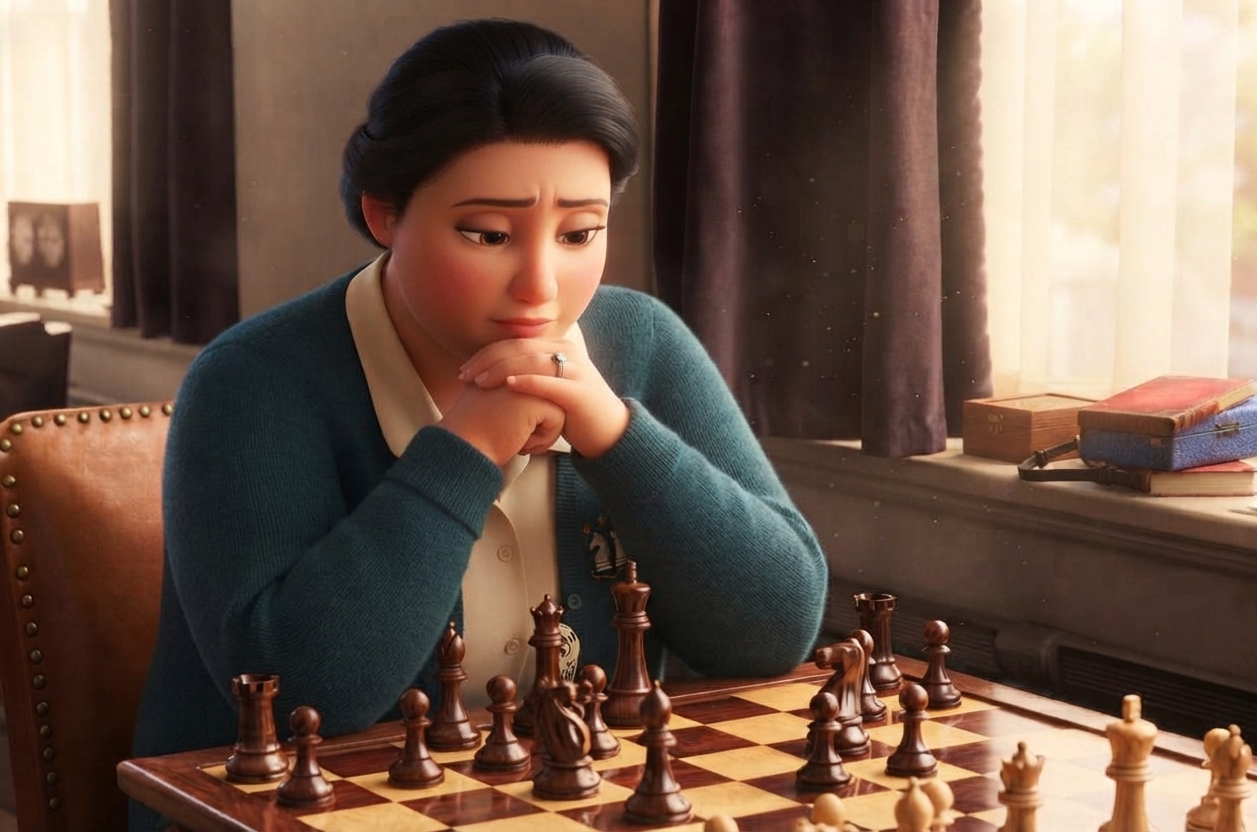
Illustration of Vera Menchik at the chessboard. This is not a real picture of her, and the board shown is not a position from a real game.
Let us start with a puzzle. It is White's move. White's king stands right beside two black pawns, on f7 and h7, and could take either one. But Black has a pawn on b4 that is three steps from becoming a queen, and a bishop on b3 that can step out of its way. One move keeps the game close. The move that looks most natural, grabbing a pawn, loses quickly. Keep it in mind: you will meet the answer in the game below.


White to move. The black pawn on b4 is three steps from b1, and the bishop on b3 will move out of its way. White can take a pawn on f7 or h7 with the king. Only one move keeps the game close. Find it.
The player with the black pieces was Vera Menchik. She was the first Women's World Champion, and she won this game against Max Euwe, who became world champion himself in 1935.
A Champion from Moscow
Vera Menchik was born on 16 February 1906 in Moscow, in Russia. Her father, František Menčík, came from Bohemia, in what is now the Czech Republic. Her mother, Olga, came from an English family. Vera's father taught her chess when she was nine. At 14 she played her first tournament, at her school, against other students and teachers. It was never finished, but she was on her way to second or third place.
Then the world around her changed. After the Russian Revolution her family lost its comfortable life in Moscow, and in 1921 Vera, who was 15, left Russia with her mother and her younger sister, Olga. They moved to Hastings, a seaside town in England, to live with their grandmother. Vera spoke only Russian. Chess helped, because you can play a whole game without many words.
On 18 March 1923, at 17, she joined the Hastings Chess Club. She had two coaches: James Drewitt, who was that year's club champion, and the Hungarian master Géza Maróczy. She was not known for tactical attacking play, but she was especially good at turning small advantages into wins.
Climbing to the Top
- In 1925 she played the British women's champion, Edith Price, in two five-game matches and won both, 3-2 each time.
- In 1927, at 21, she won the first Women's World Championship, played in London. She scored 10½ points out of 11 and drew only one game.
- She held the title until 1944, nearly 17 years. That is the longest reign in the history of the women's title.
- She did not only play women. In 1929 at Ramsgate, in England, she did not lose a single game against strong British players, and she shared second place with the great Akiba Rubinstein, half a point behind José Raúl Capablanca.
- That same year she was invited to the big Carlsbad tournament, in what is now the Czech Republic. She was the only woman among 22 of the best players in the world, and she finished last, with 3 points out of 21. Something famous came out of it.
The Vera Menchik Club
The story goes that before the Carlsbad tournament, or early in it, a strong Austrian master named Albert Becker laughed at the idea of a woman playing there. He joked that any player who lost to her should be let into the "Vera Menchik Club". In round 3, Becker himself lost to her, and he became the first member. That round and that result are in the game record, and you will find the game among the five below.
The joke does not seem to appear in any source from 1929, so the story may have grown a little in the telling. But the Club was real enough. By early 1931 the English master Sir George Thomas was already being called its "president", because he kept losing to her. Other players said to have joined include Max Euwe, Samuel Reshevsky, Friedrich Sämisch, Edgard Colle and Mir Sultan Khan. Losing to Vera Menchik became part of chess history.
The Game: Max Euwe vs. Vera Menchik, Hastings 1930/31
Max Euwe 0-1 Vera Menchik Hastings Christmas Congress, England, 1930/31 · Round 2 · 30 December 1930 White: Max Euwe · Black: Vera Menchik
Euwe was already one of the strongest players in the world. He won this tournament with 7 points out of 9, ahead of the former world champion Capablanca, and this was the only game he lost.
1.d4 Nf6 2.c4 e6 3.Nc3 d5 4.Bg5 Nbd7 5.e3 Be7 6.Nf3 O-O 7.Rc1 a6 8.cxd5 exd5 9.Bd3 c6 10.O-O Ne4 11.Bf4 Nxc3 12.Rxc3
This is the Queen's Gambit Declined: White offers a pawn on c4, and Black says no thanks and defends with ...e6. She often used it against 1.d4. Euwe put his bishop on g5, where it eyes the knight on f6, and Black castled to make her king safe. After White took on d5 and Black took back, Black had pawns on c6 and d5, a solid wall in the centre.
Black's pieces had little room, and the knight trade with 10...Ne4 and 11...Nxc3 gave the rest more space. An old rule of thumb says that when you are short of space, you should trade pieces.
13.Qb1 Nf8 14.b4 Ng6 15.Bg3 Bd6 16.a4 Bxg3 17.hxg3 Bd7 18.Rfc1 Qf6 19.b5 axb5 20.axb5 Rec8 21.Qc2 Qd8 22.bxc6 Rxc6 23.Rc5 Rxc5 24.dxc5 Ra5 25.Qb2 Qa8 26.Qb6 Nf8 27.Ne5 Ra1 28.Rb1 Rxb1+ 29.Bxb1 Be6 30.Kh2 Nd7 31.Nxd7 Bxd7 32.Qc7 Qc8 33.Qxc8+ Bxc8
Euwe pushed his pawns on the queenside and traded a lot of pieces, including all four rooks. On move 33 the queens came off too, and the game became an endgame.
bAfter 33...Bxc8, White to move. Each side has a bishop and five pawns, and both bishops run on light squares. Black's pawn on d5 has no pawn beside it on the c- or e-file, so White's bishop can go after it.
Here each side has a bishop and five pawns. Our own Stockfish 17.1 Lite check at depth 22 gives White a small edge, about six tenths of a pawn. The reason is the pawn on d5. It stands alone, with no friend on the c-file or the e-file, and chess players call that an isolated pawn. A lone pawn is hard to defend.
34.Ba2 Be6 35.Kg1 Kf8 36.Kf1 Ke7 37.Ke2 Kf6 38.Kd3 Ke5 39.g4 g5 40.g3 Bxg4 41.f4+ gxf4 42.gxf4+ Kf6 43.Bxd5
In an endgame the king stops hiding and starts fighting. Both kings walked to the middle of the board. Menchik took a pawn on g4 with her bishop, but Euwe got it back with 43.Bxd5, winning the isolated pawn.
After 43.Bxd5, Black to move. Each side has a bishop and three pawns. Black's pawn on h7 is a passed pawn: no white pawn can block it or capture it on its way down the board.
Now the pawns were equal again, three each. Black had one good thing: the pawn on h7 is a passed pawn, which means no enemy pawn stands in front of it or beside its path. White's c-pawn, on the other side of the board, was not passed, because Black's pawn on b7 guards the squares in front of it. Euwe had the better game, about nine tenths of a pawn by the engine's count, and after Menchik's reply it grew to about 1.3 pawns. Then his edge slipped. Our engine marks 44.Bf3 as the move where it happened, and likes 44.Ke2 or 44.Ke4 instead.
44.Bf3 Ke7 45.Kc4 Kd8 46.Kd5 b6 47.c6 Kc7 48.Ke5 Be6 49.f5 Bb3 50.Kf6 b5 51.Kg7 b4
After 47...Kc7, White to move. White's pawn on c6 is passed, and so are Black's pawns on b6 and h7. Our engine says the game is level.
By move 47 the game was level. White's c-pawn on c6 was blocked by the black king, and Black had two passed pawns of her own, on b6 and h7. Both sides now had a plan. Euwe's king marched toward the pawns on f7 and h7. Menchik's b-pawn marched down the board toward b1.
This is the position from the puzzle at the top. Euwe played 52.Kxh7?, grabbing the pawn, and our engine says that was the decisive mistake. Before it, Black was ahead by about a quarter of a pawn. After it, Black was more than four pawns ahead. The right move was 52.Bh5. It attacks the pawn on f7, so White has something to play for too. At depth 24 our engine rates 52.Bh5 at about six tenths of a pawn in Black's favour, and the next best move, 52.Kf6, at almost three pawns. After the king grab our engine says White is lost, and the rest of the game shows how.
52...Bc2 53.Kg7 b3 54.Bd5 b2
 8
8
 72
72 1a
1a bc
bc defgh
defghAfter 54...b2, White to move. The black pawn is one step from b1, where it would become a queen. White's bishop has to get back to guard that square.
The pawn is one step from becoming a queen. White's bishop went back with 55.Ba2. From a2 it watches the b1 square, and as long as it stays there, the pawn cannot step forward.
55.Ba2 Kxc6 56.f6 Kd6 57.e4 Bxe4 58.Kxf7 Bd5+
Here is the clever part. The bishop on a2 had one job, guarding b1. Menchik gave a check with her bishop: 58...Bd5+. White had five legal moves, and none of them helped. If White took the bishop with 59.Bxd5, the guard on b1 left its post. If White moved the king instead, Black's bishop would take the white bishop on a2, and the guard would be gone anyway. Euwe took.
59.Bxd5 b1=Q 60.Kg7 Qg1+ 61.Kf8 Kxd5
The move 59...b1=Q is called promotion: a pawn that reaches the last row turns into a queen. Count the pieces as a beginner would, with a pawn worth 1 point, a bishop 3 and a queen 9.
bAfter 59...b1=Q, White to move. Black has a queen, worth 9 points. White has a bishop and a pawn, worth 4. The black king stands next to the white bishop.
Black has 9 points against White's 4, and Menchik's queen checks the king and then her own king takes the last white bishop. The game score ends here with 0-1.
What to Learn from This Game
- Count the race before you grab a pawn. Menchik's b-pawn needed three moves to become a queen. Euwe grabbed a pawn in a game that was still close, and our engine says he was lost from that moment. Ask: how many moves does their runner need, and what will my move cost me?
- A passed pawn far from the action is a weapon. The b-pawn pulled White's bishop back to guard b1, and that one job was all it took to make White's pieces too busy.
- A piece can only guard one thing at a time. The bishop on a2 could not guard b1 and also take care of the check on d5. When you see a piece with a single important job, ask whether a check or a capture can pull it away.
Five More Games to Study
- Vera Menchik vs. Albert Becker, Carlsbad, 1929 (1-0). The game that started the Vera Menchik Club. Our engine gives Menchik a small edge from the opening and watches it grow, to about a pawn and a half by move 20 and more than three pawns by move 32. The game ends with a little trick: 40.e6+, a pawn check that is also a fork, one piece attacking two things at once. The pawn hits the black king on f7 and the rook on d7, so she wins the rook.
- Vera Menchik vs. Edgard Colle, Paris, 1929 (1-0). Colle was a strong master. Our engine says Menchik was slightly worse around moves 16 to 20, but 23...Nxd4 and 26...Red8 gave the advantage to her. After 30.Rd8+ her rooks and queen chased the black king from g8 all the way to h5, and at the end our engine sees a forced checkmate.
- Vera Menchik vs. Max Euwe, Hastings, 1931/32 (1-0). Her second win over Euwe. After 11.Bb5+ Euwe played 11...Ke7, which our engine marks as a mistake, and Menchik opened the centre with 12.e4 and 14.e5 while his king had no shelter. It is a long win, 56 moves, and from move 12 to the end our engine has Menchik ahead by about two pawns or more.
- Vera Menchik vs. George Thomas, London, 1932 (1-0). A short, sharp attack in 24 moves. Menchik castled on the queenside, pushed her pawns g4, h4 and h5 at Thomas's king, and our engine finds a forced mate in three after 23...fxg6. Try the position below before you read on.
- Vera Menchik vs. Eero Böök, Margate, 1938 (1-0). Böök was a strong master from Finland. After 34...Nc3, which our engine marks as a mistake, Menchik played a combination that wins Black's queen. Try that position below too.
Two Positions to Try
Menchik was known as a patient player, but these two positions show that she could attack when the chance came.
872bdfgMenchik vs. Thomas, London 1932, after 23...fxg6. White to move. There is a forced checkmate in three moves, and it begins with a queen sacrifice.
The answer is 24.Qxh7+, a queen sacrifice, which means giving up the queen on purpose. Black's king has only one legal reply, 24...Kxh7. Then 25.Rh1+ forces 25...Bh3, the only move that stops the check, and 26.Rxh3 is checkmate. After the last move the pawn on f6 covers g7, the white rook covers the h-file, and the king's own rook on g8 and pawn on g6 block its escape.
64dgMenchik vs. Böök, Margate 1938, after 37...Kxh7. White to move. The white queen on c2 looks along the diagonal toward the black king, and only the white knight on g6 is in the way. Find the move that wins the black queen.
The answer is 38.Ne5+. When the knight leaves g6, the queen on c2 gives check down the diagonal. This is called a discovered check. The knight also attacks the black queen on f7. Black must answer the check, and Menchik takes the queen with 39.Nxf7.
A Short Life and a Long Reign
Vera Menchik kept playing in tournaments in England during the Second World War. In June 1944 a German flying bomb hit the family's home in Clapham, in south London. She died, and so did her mother and her sister Olga. She was 38.
Her name lives on. The team prize at the Women's Chess Olympiad is called the Vera Menchik Cup, and the Hastings Chess Club still keeps some of her medals. For nearly 17 years no woman could take her title away.