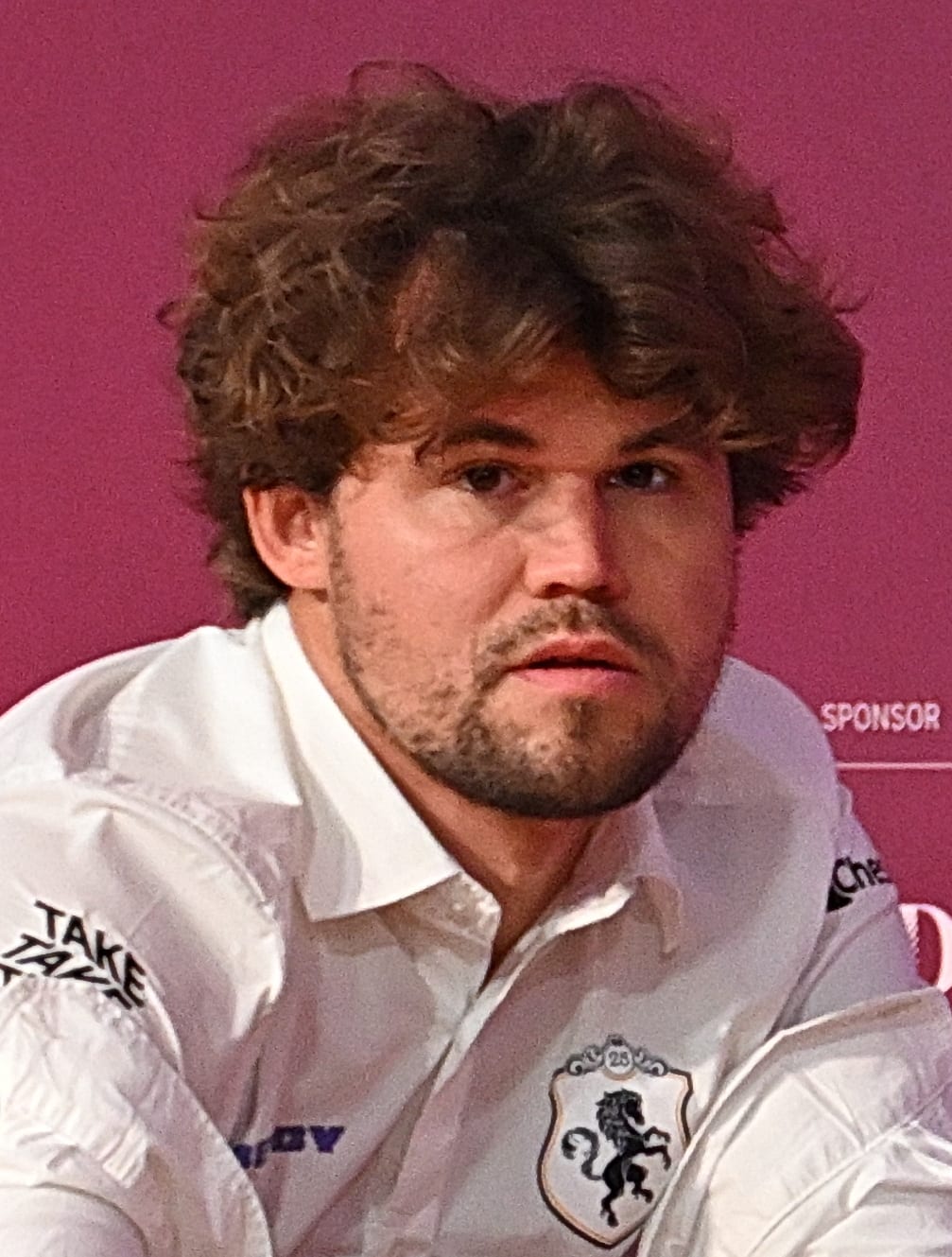
Photo: Miroslav.vajdic / Wikimedia Commons (CC BY 4.0)
On 16 November 2013, in Chennai, Magnus Carlsen sat in a rook ending that the experts watching expected to be drawn. He was a pawn up, and then two pawns up, and he did not take the safe road. He gave both pawns back. By move 67 he had won the game and led the World Championship match 4-2.
Game 2 of the next title match, Gukesh against Sindarov, is tomorrow. Before it starts, here is a rook ending to study. It is the next piece in our run-up series, after Fischer's win over Spassky in 1972. You can also read how both players grew up in Magnus Carlsen's childhood story and Viswanathan Anand's.
The setting
Anand was the world champion and Carlsen was the challenger. After five of the 12 games Carlsen led 3-2, after winning game 5 the day before. Anand had White in game 6.
Opening and middlegame: keep the queens on
Anand 0-1 Carlsen World Championship 2013, Chennai · Game 6 White: Anand · Black: Carlsen
This was a Spanish Game, the opening that starts . It was quiet, and many pieces came off the board. After Black could have played 24...Qe6, which would have allowed a queen trade. Carlsen played and kept the queens on. A queen trade makes a draw more likely. Carlsen said afterwards that he wanted to "press him a little bit" that day, because "there was really not much to risk."
Now it was Anand who made the decision. With he let Black take a pawn on e4. After the queens were off, and Black was a pawn ahead in a rook ending. Rook endings with a one-pawn lead are often drawn, because the side with fewer pawns can keep an active rook.
After 40...Rxe7, White to move. White has four pawns and Black has five.
Two pawns up, and still level
With White gave up a second pawn. Carlsen said afterwards that he had missed the idea: "I didn't really think you could give up a pawn like that." The idea was to break up Black's pawns on the kingside. After , Black has five pawns to three, but two of them sit on the h-file, one in front of the other, and they are hard to use.
After 44...gxh5, White to move. Black has five pawns to three, but the pawns on h6 and h5 are doubled.
Our engine, Stockfish 17.1 at depth 20, thinks the position is close to level from here on. It never gets more than half a pawn away from a draw between moves 45 and 59. Anand defended well for a long time. After his rook stood on the fifth rank, where it attacks the pawns on b5 and h5 at once, and Black's rook was stuck guarding b5. Carlsen's way out was to let the b-pawn go with and free his rook with .
Look at what happened to Black's extra pawns. took one, and took the other. Carlsen let both go. In return, his king walked to e3, right into White's camp. Carlsen later called this king walk "one little trap." Black's rook on g3 and the pawns on f4 and h4 were ready to run.
Look at White's own pawns on b2 and c3. They stand on the third rank, the same rank as Black's king, so they block White's rook from checking along it. A white rook on a3 cannot check the king on e3, because the pawn on c3 is in the way. White's pawns hurt him, and Black's king and f-pawn are far advanced. That is why king position matters so much in rook endings.
After 59...f4, White to move. Each side has three pawns. Black's king is on e3 and the pawns on f4 and h4 are far advanced. Our engine finds only one move that holds the draw: 60.b4.
The only move
At this point the position was still a draw, but only just. In our engine's depth 22 count, 60.b4 is the single move that holds, worth about a quarter of a pawn for Black. The next best, 60.Rc7, is worth more than two pawns for Black. The idea is that White's b-pawn gets moving too, and gives him chances of his own.
Anand played . It looks natural, because the rook attacks the pawn on f4, but it leaves the b-pawn at home. Carlsen answered .
After 60...h3, White to move. If White takes with 61.gxh3, no white pawn stands on the e, f or g file, so Black's f-pawn is a passed pawn.
This is the third idea to learn. A pawn sacrifice can create a passed pawn, and a passed pawn with a rook behind it wins games. Our engine puts Black ahead by more than three pawns after .
The finish
White's rook could give a few checks, but it could not stop the f-pawn, and came four moves too late.
After 67...Rg1, White to move. The pawn on f2 is one step from queening on f1, and the rook on g1 guards that square. Our engine gives Black an edge of more than ten pawns.
Carlsen won the game and led 4-2. He went on to win the match 6½-3½, finishing it after ten of the 12 scheduled games, and became world champion.
What Carlsen Can Teach You
- If you want to win, keep the pieces on. 24...Qe7 avoided a queen trade that would have helped a draw.
- Material is a tool. Carlsen gave two pawns back to get his king active and a passed pawn on the f-file.
- In a rook ending, king activity matters as much as pawns. His king on e3 did the work.
- A passed pawn with a rook behind it ties down the defender. Look for the pawn break that makes one.
- Look at your own pawns. Pawns on the same rank as the enemy king can block your rook's checks.
- When you defend, check for the only move. A natural move like 60.Ra4 can lose when another move holds.
What came next
Anand fought on and drew several games, but Carlsen won game 9 as well. Now Gukesh defends the title against Sindarov. Read our Game 1 report for what happened in Geneva.