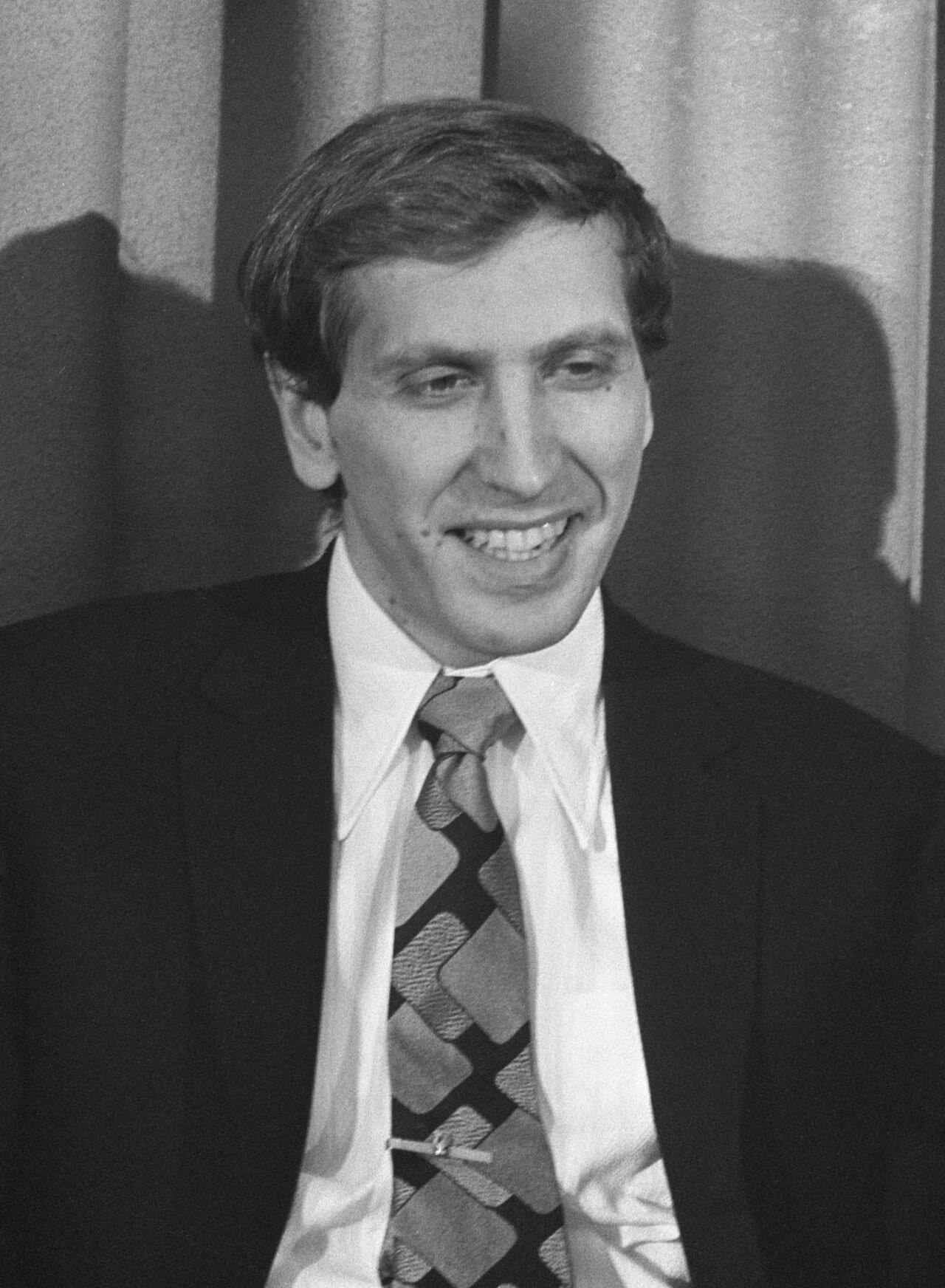
Photo: Bert Verhoeff for Anefo / Wikimedia Commons (CC0)
On 23 July 1972, in Reykjavik, Bobby Fischer pushed his c-pawn two squares. Fischer almost always began with the king's pawn, so the opening move was already a surprise. The World Championship against Boris Spassky was level at 2½-2½. When the game ended, Fischer led the match for the first time, and Spassky applauded him along with the crowd.
Game 1 of the next title match, Gukesh against Sindarov, was drawn in Geneva this week. Game 2 is tomorrow. Before it starts, here is a title game that teaches how a calm position turns into a win. It follows our run-up pieces on Kramnik against Kasparov and Ding against Nepomniachtchi. You can also read how both champions started out in Bobby Fischer's childhood story and Boris Spassky's.
The opening: Fischer changes the plan
Fischer 1-0 Spassky World Championship 1972, Reykjavik · Game 6 White: Fischer · Black: Spassky
After this was the Queen's Gambit Declined. Spassky chose a setup with that is named after Savielly Tartakower. Then the pieces started to come off the board.
Fischer's queen went to a4 and then a3, a quiet square that keeps an eye on the queenside. These moves had been played before. In Moscow in 1970, Semyon Furman beat Efim Geller with the same moves up to , and was Furman's new idea. Geller was one of Spassky's helpers for this match. In 1970 Geller played 17...a5 here. Spassky played .
Our engine, Stockfish 17.1 at depth 20, thinks the game was close to level until about move 16. It starts to prefer White a little after , where its first choice is 16...Qb7.
Trade into a good bishop
White's knight took Black's bishop. Count what was left on the board: each side had a queen, two rooks and six pawns. White had a bishop. Black had a knight. Black had no bishops at all.
After 19...fxe6, White to move. White has a bishop, Black a knight. The pawn on e3 can step forward and attack the pawn on d5.
Open the centre with
attacks the pawn on d5. This is a pawn break, a push that challenges the other side's pawns. Our engine at depth 22 picks as White's best move, worth about half a pawn. The other good tries, 20.b3 and 20.Qa5, are worth about a quarter.
Count the pawns on the kingside after . White has four there (e4, f2, g2 and h2) and Black has three (e6, g7 and h6). That is a majority, and White's plan is to push the f-pawn and the e-pawn to attack Black's king.
Black answered with . Our engine prefers 20...dxe4, but only by about a third of a pawn, so this is not a blunder. After White's pawns could march forward, and Black had no bishop left to fight for the light squares. After the pawn on e5 is guarded by the pawn on f4, and it attacks f6, so Black's knight on d7 cannot jump there.
After 22.e5, Black to move. The pawn on e5 is guarded by the pawn on f4 and it attacks f6.
Aim two pieces at the weak pawn
Black's pawn on e6 is now a target. Look at it after .
After 24...Nf8, White to move. The bishop on c4 and the queen on h3 both attack the pawn on e6. Black guards it twice, with the queen and the knight.
Two attackers against two defenders is not enough to win a pawn. It is enough to tie Black's pieces down, which is the idea. A defender that must stay put cannot help anywhere else.
Break open a file
White's next step was . It offers a pawn to open the f-file for the rooks. After , each side still had five pawns, so nothing was lost. White's rook now looked at the black king's side, and Black's pieces had less room.
After 27.Rxf5, Black to move. Both sides have five pawns. White's rook on f5 and queen on h3 now point at Black's king.
A pawn wedge on e6
The pawn stepped to e6, deep in Black's camp. It is guarded by the bishop on c4. Black's rook on e7 attacks it, but cannot take it, because the bishop takes back. A pawn that deep is called a wedge: it splits Black's pieces and takes squares from them. Our engine now has White ahead by about three and a half pawns.
After 31.e6, Black to move. The pawn on e6 is guarded by the bishop on c4, so the rook on e7 cannot win it.
The finish
For a few moves White improved his rooks and bishop, while Black's queen went back and forth between d8 and e8. Then put the knight in front of White's rook. gave a rook for a knight and a pawn, and the black king had lost its cover.
Black's rook could not take the pawn on e6 earlier. After Rxe6, the line 38.Rf8+ Nxf8 39.Rxf8+ Qxf8 40.Qh7 is checkmate, and our engine finds it as a forced mate in three. Black played instead.
After the queen and the rook both attack the pawn on h6. White threatens 42.Rxh6+, a check that tears open Black's king. For example, after 41...Rc8 42.Rxh6+ Kg8 43.Qg4+ Rg7 44.e7+ Qf7 45.Qxc8 is checkmate. Our engine gives White an edge of more than 15 pawns even after Black's best reply, 41...Kg7.
After 41.Qf4, Black to move. The queen and the rook on f6 both attack the pawn on h6, next to Black's king.
The game score ends there, 1-0. The win put Fischer ahead, 3½-2½, for the first time in the match. He went on to win the match 12½-8½ and became the 11th world champion.
What Fischer Can Teach You
- Trade for the piece you want. White traded a knight for a bishop, then kept a bishop against a knight with Black's pawns on light squares.
- Use a pawn break to change the centre. 20.e4 made a plan out of a quiet position.
- Attack a weak pawn with two pieces. Even if the pawn does not fall, the defenders are stuck.
- Open a file for your rooks, then bring them to the side where the enemy king lives.
- A pawn on the sixth rank, guarded by a bishop, can cramp a whole army.
- Know the games in your own opening. 14.Bb5 and the moves before it had been played before, in a game that one of Spassky's own helpers lost.
What came next
In game 7 Spassky played 1.e4 for the first time in the match, but the title went to Fischer. Now two new players write their own story. Read our Game 1 report for what happened in Geneva.
Next in the run-up series: Carlsen against Anand, 2013.